
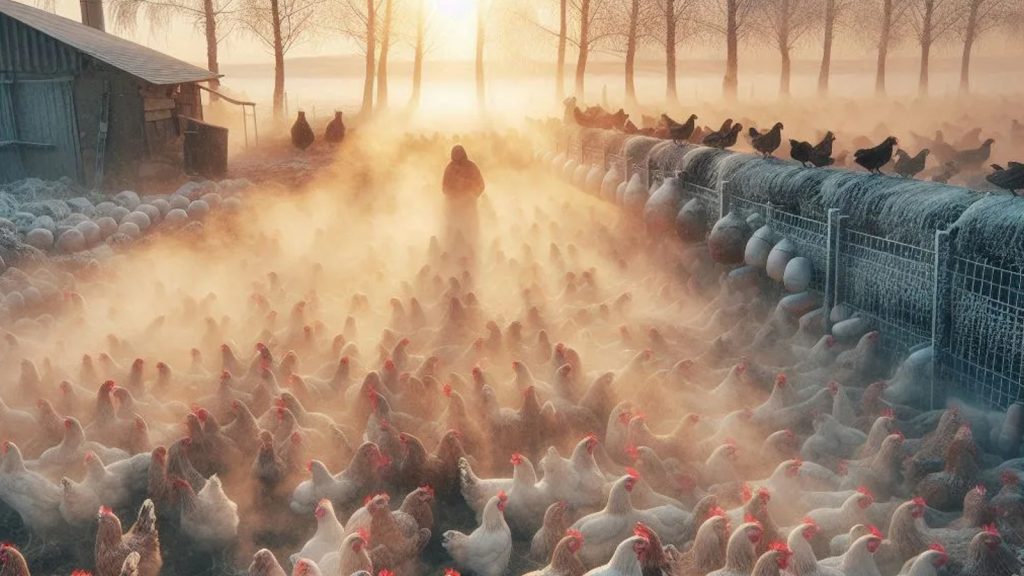
Managing breeder and layer flocks in cold climatic conditions is one of the key challenges in the poultry industry. In such environments, controlling temperature, humidity, and ventilation plays a critical role in maintaining bird health, reducing cold stress, and preventing production losses. Proper house design and precise ventilation management are determining factors for successful poultry production in the cold season.
Types of Poultry House Design
Poultry houses are generally categorized based on their level of environmental control:
- Fully controlled houses with environmental management systems
- Semi-closed houses with tunnel ventilation
- Open-sided houses with limited ventilation
- Fully open houses without advanced ventilation systems
Each system has different performance in temperature and airflow control and requires more precise management in cold conditions.
Role of Temperature and Humidity in Cold Weather
Outdoor temperature fluctuates throughout the day and night, with more severe variations in mountainous and desert regions. Relative humidity also changes along with temperature.
Temperature–Humidity Relationship
There is an inverse relationship between temperature and humidity:
as temperature increases, humidity decreases, and vice versa. This directly affects internal house conditions and, if not properly managed, can lead to cold stress in the flock.
Importance of Ventilation in Poultry Houses
The main goal of ventilation is to supply fresh air and remove harmful gases such as ammonia, dust, and excess moisture. During cold nights, ventilation must be carefully controlled to avoid excessive humidity or unwanted temperature drops.
Problems of Improper Ventilation
- Increased ammonia levels in the house
- Respiratory disorders in birds
- Cold stress
- Reduced production performance
Tunnel Ventilation in Cold Weather
Tunnel ventilation systems must be used cautiously in cold conditions, as introducing cold air from a single point can cause sudden temperature drops inside the house.
Limitations
- Large fans are not recommended when minimal ventilation is required
- Smaller, controlled fans are more suitable in cold weather
- Combining minimal ventilation with pressure control systems yields better results
Minimum Ventilation and Airflow Control
In modern systems, the use of small air inlets combined with side fans allows for uniform airflow distribution. This helps prevent cold spots and ensures more stable internal temperatures.
Humidity Control
Relative humidity (RH) is a key parameter in ventilation management. Maintaining humidity below 70% is generally considered an indicator of proper ventilation performance.
Importance of Monitoring
Using humidity measurement devices helps optimize ventilation settings and prevent respiratory issues.
Effect of Air Temperature on Moisture Capacity
Warm air can hold more moisture, while cold air has lower moisture-holding capacity. This phenomenon, known as the “sponge effect,” plays an important role in environmental management.
Importance of Air Mixing
To prevent cold spots, incoming air must be properly mixed with warm indoor air. This is usually achieved through small air inlets, ensuring uniform temperature distribution throughout the house.